An investment committee memo, built from your data pack.
Send the commercial due diligence data pack: market numbers, the target's performance, the management plan and your expert calls. FrameBind turns it into an IC memo deck with the answer up front, then hands you the .pptx to finish.
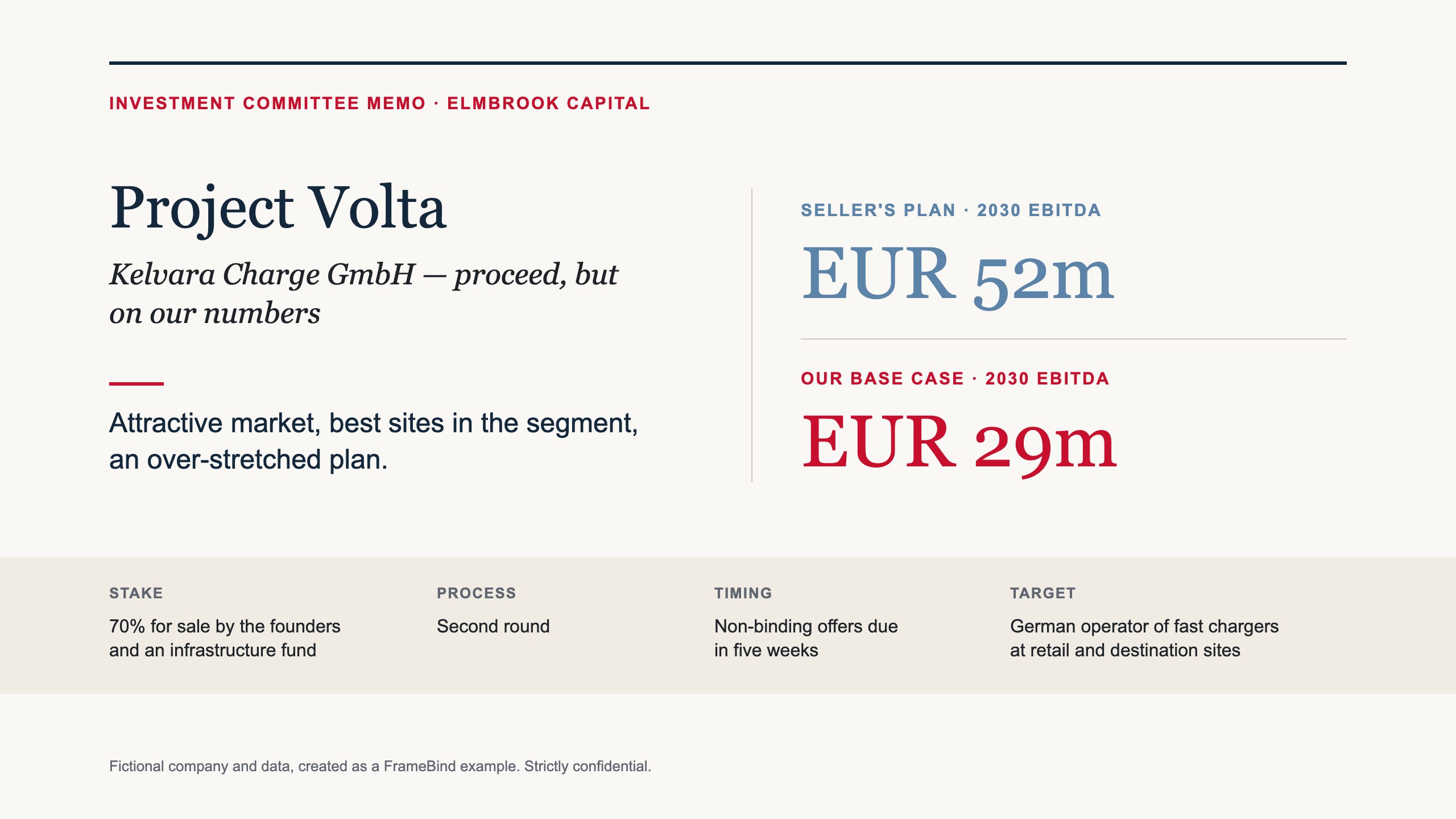
A real example, exactly as it downloaded.
What went in
A fictional commercial due diligence data pack on Kelvara Charge, a German EV charging operator, written for this example: about 1,150 words and 8 tables covering the market, the competition, site cohorts, unit economics, the management plan against a base case, an EBITDA sensitivity grid, expert-call summaries and the risks flagged so far.
- Source: a fictional 8-table DD data pack (Word)
- Audience: an investment committee
- Output: 14 slides, 3 native tables
What came out
“Project Volta: IC Memo”: 14 slides in an original design (Data journalism direction), with 3 native tables you can edit in PowerPoint. Nothing was touched up after export. Click a slide to page through it, or open the file yourself.
Download the .pptx129 KBThe storyline, slide by slide.
Every headline in the deck, in order. This is the outline you approve before anything is built.
- 01Kelvara Charge GmbH: proceed, but on our numbers
- 02Our answer: an attractive market and strong sites, but an over-stretched plan. Proceed to confirmatory DD
- 03Public charging in Germany grows ~26% a year to EUR 8.5bn by 2030 in our base case
- 04Destination charging, Kelvara's segment, is large and grows faster than highway
- 05Kelvara is only fourth by size but has the segment's best utilisation at 14.5%
- 06Revenue grew sevenfold since 2022 and EBITDA turned positive, but net debt reached EUR 98m
- 07The edge is site selection, and it is concentrated in the 2022 cohort
- 08Our base case delivers EUR 29m of 2030 EBITDA, little more than half the plan's EUR 52m
- 09Even 18% utilisation at EUR 0.60 yields EUR 50m on our network, still short of the plan
- 10Grid queues cap openings at ~110 sites a year: 950 sites by 2030, not 1,200
- 11Six risks drive the case. Grünkorb concentration and price pressure matter most
- 12What we must believe: four thresholds that separate our case from the plan
- 13Expert calls confirm the thesis but warn against extrapolating the early sites
- 14Recommendation: proceed to confirmatory DD, value on our base case, and meet five conditions
You approve the plan. Then you get the file.
Send the data pack.
Market model outputs, the target's KPIs, the management case, expert-call notes, in one PDF or Word file up to 50 MB. Say what the committee has to decide.
Approve the storyline.
Check the answer, the key questions and every slide headline before anything is built. If the plan leads with the market and you want the recommendation first, say so.
Finish it in PowerPoint.
Sensitivity grids and plan-versus-base-case tables come through as real PowerPoint tables. Re-cut the numbers in PowerPoint when the model moves.
What you still do
The slides are shown exactly as they downloaded, including a small text overlap on slide 6 that you would fix in PowerPoint in a few seconds. An IC memo carries your firm's view, so read every number against your model before it goes to the committee.
Questions.
More in the main FAQ, or email contact@framebind.com.
Send the material behind your next deck.
Plans from $149 a month, or try one deck for $49. A deck that fails goes back to your allowance automatically.